 Brian Dolan: Research Activities Brian Dolan: Research Activities
  Black Holes and Quarks - the Cosmic Connection:
a non-technical description of some of my research interests in Particle Physics and Cosmology, for non-experts.
Black Holes and Quarks - the Cosmic Connection:
a non-technical description of some of my research interests in Particle Physics and Cosmology, for non-experts.
 List of publications from the
SLAC-SPIRES database, with citations.
List of publications from the
SLAC-SPIRES database, with citations.QCD is named after quantum electrodynamics, its close cousin. The term chromo (colour) is used in analogy with the three primary colours: as red, blue and green mix to white, so quarks can have one of three types of colour charge which add to zero. One can imagine hypothetical worlds where QCD would be different, the strength of the colour charge could be bigger than in our Universe, for example. A remarkable fact was recently discovered in some simplified mathematical models of QCD: the predicted physical properties of many of these hypothetical worlds are very similar -- there is a symmetry relating them.
The Hall effect occurs in semiconductors placed in a magnetic field. When a slab of semiconducting material, carrying a current along its length, is placed in a magnetic field, the field pushes the moving charged particles left or right (depending on the sign of their electric charge) building up a voltage across the slab's width. Normally this voltage is proportional to the magnetic field but, surprisingly, for pure, very thin samples in high magnetic fields and extremely low temperatures, the voltage increases in a series of steps or plateaux which are precise fractions of a basic unit. This is the QHE. Experiment shows that the physical properties of many of these plateaux are very similar -- there is a symmetry relating them.
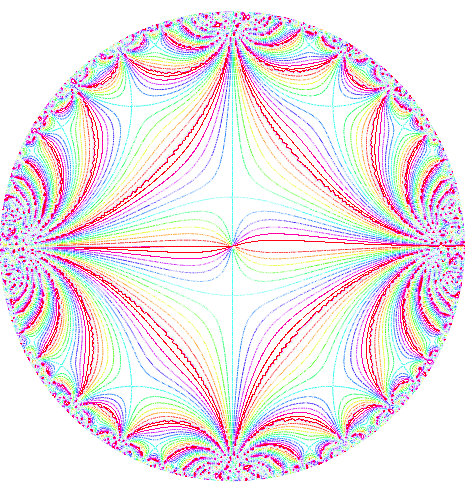
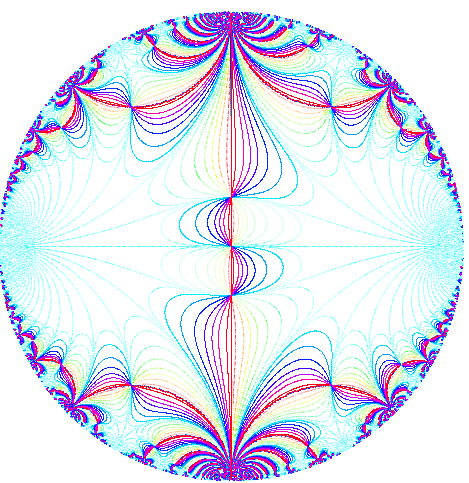
Herein lies the connection between QCD and the QHE -- they share the same symmetry! This symmetry is similar to that of a Poincaré disc. Think of points inside the disc as representing hypothetical worlds in QCD or plateaux in the QHE -- any two points which can be related to each other by the symmetry of the picture have similar physical properties.
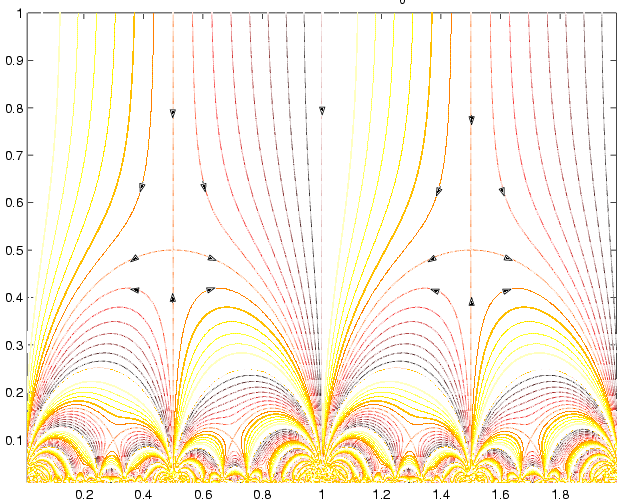
Below are two pictures of the quantum Hall effect -- the first picture
shows how the electrical conductivity of a semi-conducting slab in a
magnetic field varies as a function of temperature, as determined by the symmetry.
The vertical axis is the conductivity along the slab and the horizontal axis
is the conductivity across it. The second picture maps the conductivities
to the inside of a disc.
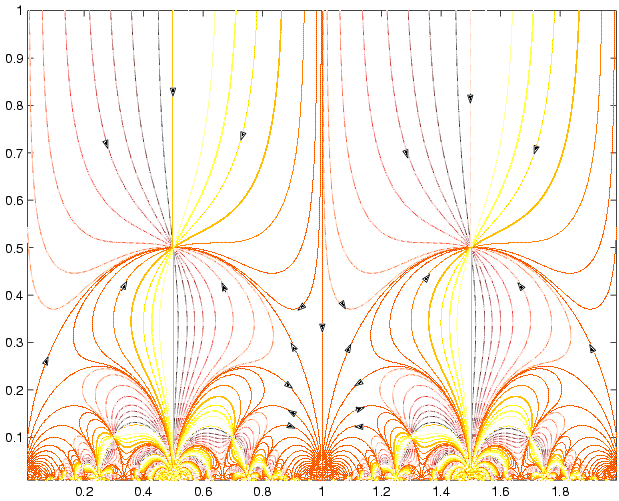
Below are two pictures of a special version of QCD (supersymmetric QCD).
The first picture has the strength of the force along the
vertical axis (weaker at the top and stronger at the bottom)
and the horizontal axis plots a measure of the degree to which time-reversal symmetry
is violated in the theory. The lines show how these parameters change
when masses in the theory are decreased. The second picture maps
these two parameters to the interior of a disc.
 Back to Brian Dolan's home page